
BY: Ashley Robinson, Editor
When Jiating Li started her studies, she never imagined she would be working with drones. The technology was new and Li had started her undergraduate studies focusing on sensors.
In her home country of China, she had studied gas sensors that monitored food quality such as the freshness of eggs. Her research path changed, though, when she received an offer to develop drone-based technologies in agriculture for her master’s work at the University of Nebraska-Lincoln.
“Drones are related to digital technology. It involves different sensors and data analysis, which perfectly matched with my research interest,” Li says in an interview.
She found herself diving deep into this new emerging technology through her master and PhD studies at the University of Nebraska-Lincoln. She then furthered her research during her post-doctoral work at the University of Illinois Urbana-Champaign, which lead her to her current work at the University of Manitoba (U of M).
“I think drones are getting into a plateau of this digital era,” Li explains. “That’s why my research is taking the next step to break through the bottleneck by moving beyond drones.”
In 2024, Li joined the University of Manitoba as an assistant professor in the Department of Biosystems Engineering. She saw research opportunities and was excited to bring her drone research knowledge to help farmers with the shorter growing seasons Manitobans face.

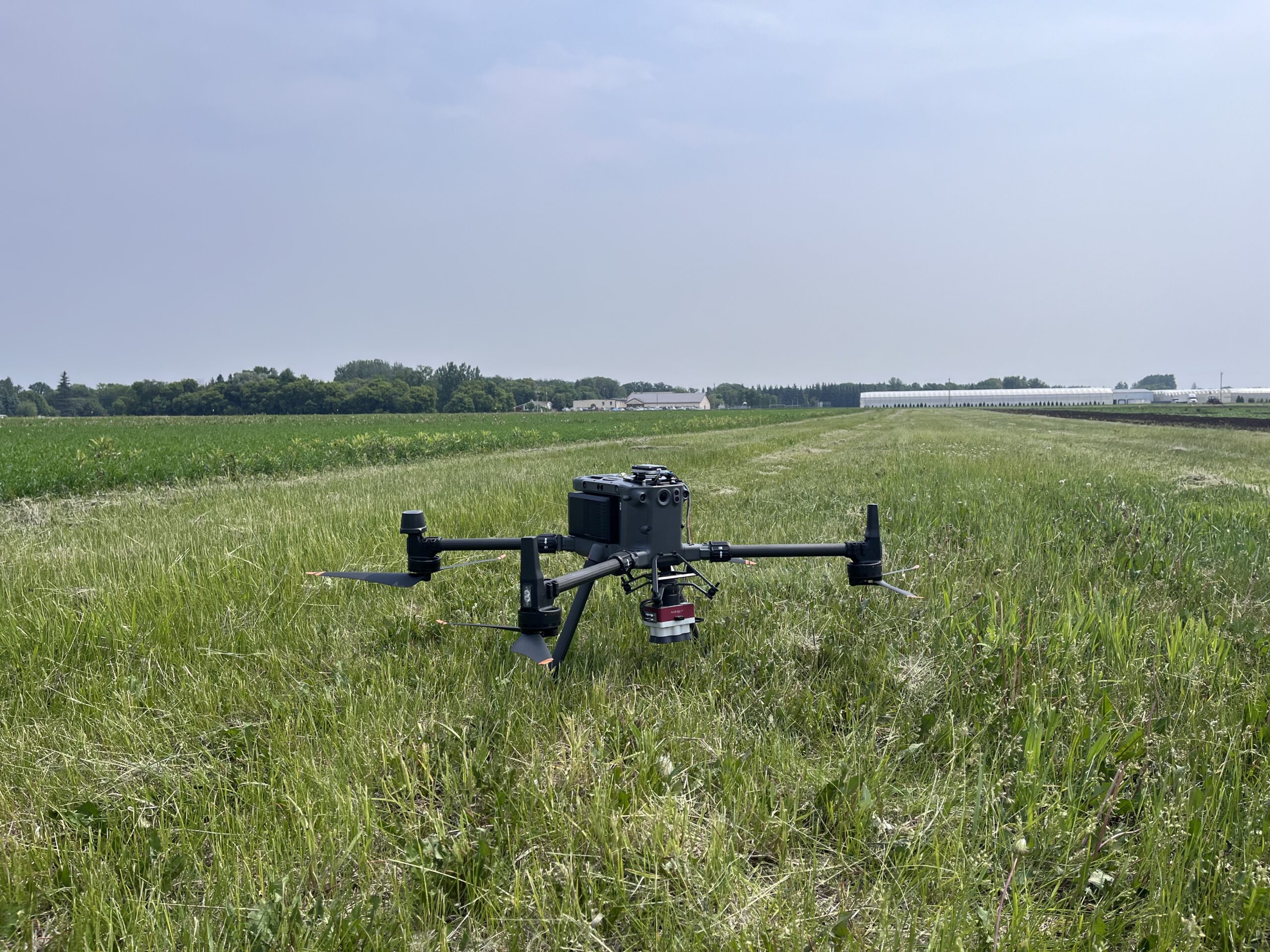
Previously, Li’s research had focused on two areas – crop management support and monitoring crops throughout the growing season. For crop management, she used drones to check for diseases and crop nutrition to calculate yield potential. For crop monitoring, she worked with crop breeders to use drones equipped with optical cameras to monitor structural, biochemical and physiological crop conditions. She also did phenotyping work with a cable-suspended system – these operate at a lower altitude than drones and provide high-quality sensing data on crop growth and development.
“Nowadays I’m starting to develop the ground-based robotics sensing as well. My vision would be a multi-scale sensing platform that can be scalable to different projects,” Li adds.
At the U of M, Li and her team are developing a ground-based robotic sensing arm for distinguishing plant disease. The robotic arm will be able to capture images from different sides of the plots – something that isn’t feasible with drones as they only capture the top of the canopy. Li is also starting to work on yield forecasting by integrating mechanistic models and AI – also referred to as knowledge-guided AI.
Li is planning to work with Manitoba Pulse & Soybean Growers on a research project. She’s awaiting approval on a project to research biological nitrogen fixation in pulse crops, specifically dry beans and soybeans.
“There is uncertainty on whether top dressing of nitrogen is needed even though soybean crops have their own nitrogen fixation,” Li says. “There is a gap of how the existing nutrients and water availability in the soil affect the biological nitrogen fixation
The research team wants to be able to provide farmers with better nitrogen application recommendations for their pulse crops. The research work will be done in collaboration with Dilshan Benaragama at the U of M and Kevin Baron with Solum Valley Biosciences.