
How Manitoba soils complement and challenge soybean and pulse production.
BY: Taryn Dickson, Extension Specialist and Writer
Manitoba Soil Landscapes
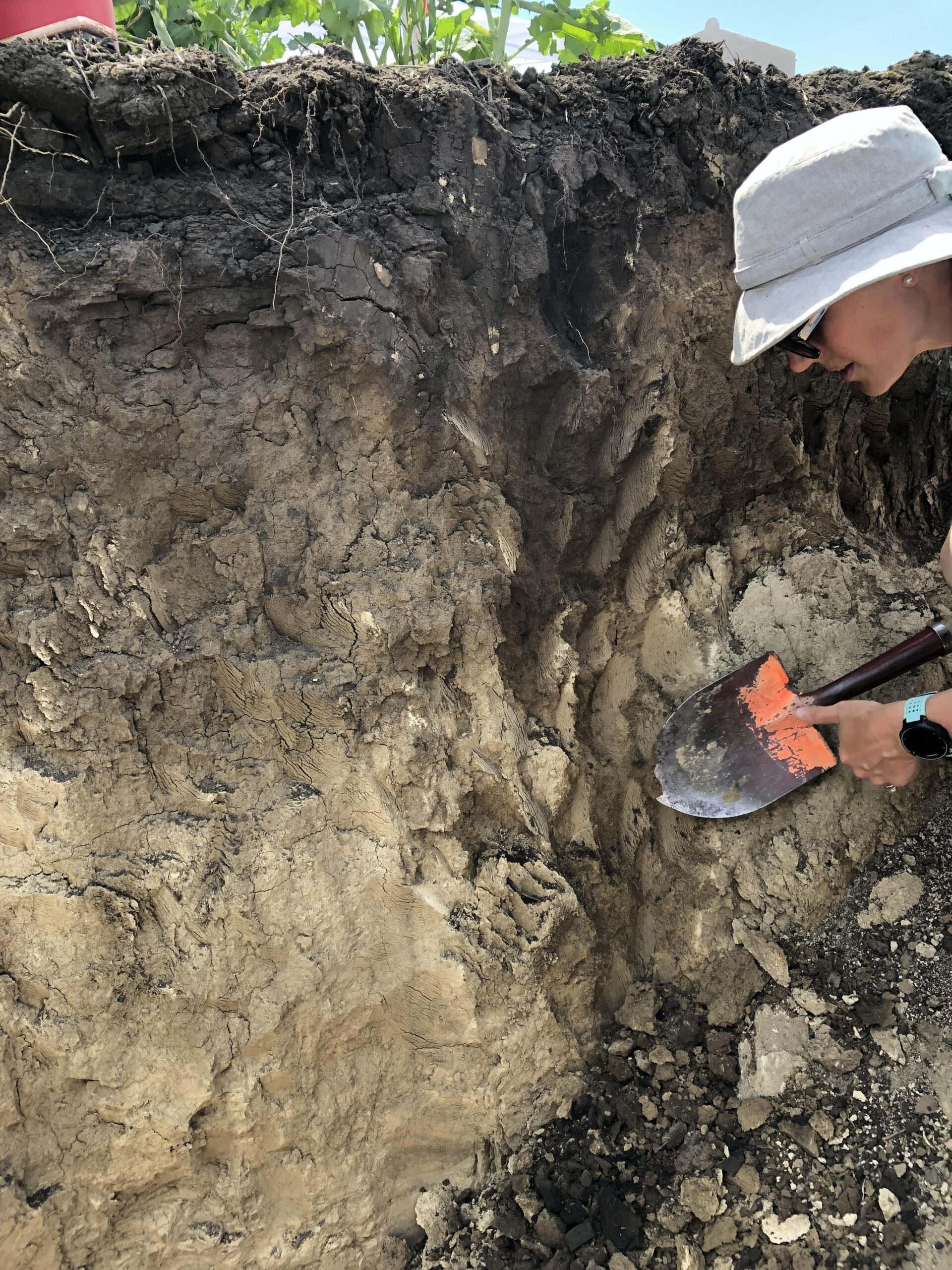
While the majestic silhouette of a bison herd against a beautiful Prairie sunset may have been appreciated by pioneers arriving on the Manitoba landscapes, the reason they wanted to stay – and the reason farmer fields cover it today – is below the surface. Manitoba soils are less than 12,000 years old, which is relatively young on the pedology scale, and provide great diversity. There are over 700 soil series in the province, each with their own distinct characteristics that contribute to each farm’s unique strengths and challenges.
One of those famous farmland soils runs along the Manitoba Escarpment. The Almasippi soil series, which agronomist and retired Manitoba Agriculture Soil Fertility Specialist John Heard highlights as an example of one of the many unique soils in Manitoba. Granite and shale influence many Manitoba soils, but the Almasippi soil features limestone bedrock parent material. This limestone is to thank for the soil’s moderately calcareous quality, which acts as a natural pH buffer and generally prevents grain farmers from needing to apply lime.

“Sandier soils in other places tend to be acidic, but not in this province,” Heard explains. “Our poorly drained ‘wet sands’ like the Almasippi are not highly leached and have retained carbonates (in comparison to the leached sandy soils in other areas, which can have lower pH).
This region makes up this and many other Black Chernozemic soils in Manitoba, thanks to deposits left behind by the glacial Lake Agassiz. These clay particles offer a high water-holding capacity that helps hold nutrients but can result in waterlogging. The lack of leaching to the imperfectly drained Almasippi soil has to do with the small, fine-textured clay particles.
Soil texture–influencing deposits of silt and sand helped shape other provincial landscapes too, including ancient rivers leaving fluvial deposits in the Pembina and Assiniboine River Valleys, stony glacial till in the Interlake, and Southwest Manitoba and the wind-deposited (eolian) materials the Spruce Woods and Sandilands parks.
Field-Scale Soil Considerations
John Heard keeps soil properties in mind as he recalls the rise in Manitoba soybean acres and parallel growth in knowledge and production improvements over the last few decades, because that foundational knowledge continues to be relevant. This was the case with nodulation in soybeans, as the soil bacteria that support nitrogen fixation in soybeans are not native to Manitoban soils, but they can survive here. So, when soybean fields were first planted in Manitoba, a double inoculation was often required to support the rhizobial communities required for good soybean yields. But now farmers who regularly have soybeans in their rotation are encouraged to consider many factors, including soil conditions and nutrient management, when choosing a suitable soybean inoculation strategy.
Similarly, in the initial years of soybean production in Manitoba, excess soil nitrate challenged successful nodulation, but it is less of a concern once rhizobium levels have been established in the soil. In cases where soils are testing high in nitrate, cereal or canola crops can better utilize those nutrients.
There are also some challenges in Manitoba related to soil characteristics.
Water is critical to all crops (and soybeans can handle great amounts of water), but, water and salinity management are related. When a high-water table is combined with a high-soluble salt content in the subsoil, the result can be soluble salts moving into the root zone or to the soil surface. This is especially challenging for soybeans, peas and field beans, which all have relatively low tolerance to salinity compared to other field crops in Manitoba.

Though this province isn’t known for its varying altitude, topographical variation within a Manitoba field should be considered, because it can contribute to variability in soil pH. For example, the erosion of topsoil on slopes can expose alkaline subsoil, which results in areas of higher pH – and potentially lower productivity – at the top of the knoll. It can also lead to lower pH in the depressions and lower slope positions.
From a nutrient perspective, Manitoba soils offer some assets and some drawbacks. While the clay and clay loam soils in Manitoba are naturally high in potassium, this isn’t the case with the sandy textured or peat soils in the province. Although they aren’t high in potassium, the sandy textured or peat soils offer sufficient iron content to sustain any crop type. However, soils rich in calcium carbonates can create environmental conditions that impede the crop’s ability to take up nutrients through the roots, which can result in plant nutrient deficiencies, such as iron deficiency chlorosis (IDC) in soybeans.
Fortunately, there are management options that start at the soil level. This can include determining which fields have a high risk of IDC (based on their carbonate and soluble salt soil test levels), scouting for symptoms, and selecting IDC resistant soybean varieties for fields with high IDC risk. Varieties are rated on a 1-to-5 scale, where ≤1.7 is tolerant (T), 1.8 to 2.2 is semi-tolerant (ST), and ≥2.3 is susceptible (S). Ratings are taken every year in Manitoba and are averaged over multiple years. These ratings can be found in both the 2026 Manitoba Seed Guide and 2026 Manitoba Grower’s Guide Pulse & Soybean Varieties.
Although soybean response to potassium (K) fertilizer may be infrequent, soybeans remove K at a much greater rate than most other crops in Manitoba. Manitoba Pulse & Soybean Growers research on “Soybean Response to Potassium Fertilization in Manitoba” reported that using estimated soybean removal rates and yields to calculate the amount of K fertilizer required to maintain K fertility throughout a rotation to support yields of other crops can be a useful long-term plan. For instance, current soil test recommendations are to apply 30 to 60 lbs K20/ac as a broadcast and incorporated application in fields with <100 ppm soil test K.
Digging a Little Deeper
The key to optimizing production from these unique and valuable Manitoba soils throughout any growing season maintaining a solid understanding of the soil properties and characteristics. From a landscape perspective, this starts with checking out resources like Manitoba Agriculture’s AgriMaps for soil, water and landform information. Then creating detailed maps and datasets from more intensive, representative soil sampling to understand and effectively manage the variation in fields. It also requires good record keeping and monitoring fields for problem areas and investigating patches of low productivity. Calculating annual nutrient balances to inform nutrient plans that fit with a multi-year rotation and creating long-term fertility goals are also effective ways to maximize the benefits of Manitoba soils to soybean production.

In addition to knowing your soil, Megan Westphal, Manitoba Agriculture’s new Soil Health Specialist, cautions that “different soil types react differently to different management, so always compare against baselines of the same soil types for useful interpretations.”
The use of new technologies can assist with monitoring and assessing soils. Ongoing research at the University of Manitoba Soybean and Pulse Agronomy Lab, started in 2024, is investigating if drones with remote sensing technology can accurately assess crop productivity in soybeans, dry beans and peas, as a way to help assess management practices.
Collection of Qualities and Critical Resource
Manitoba soils are more than just a collection of unique characteristics, and they have recently been recognized as such in a national report. The Honourable Robert Black, Senator and chair of the Standing Senate Committee on Agriculture and Forestry specifically recognized the black soil zone in Manitoba as “a highly productive soil that is more resilient in the face of degradation” in the 2024 report Critical Ground: Why soil is essential to Canada’s economic, environmental, human and social health.
With a good foundation, valuable qualities and youth on its side, Manitoba soils aren’t only resilient, they are also a key reason to farm in this province.
Key Takeaways
- Identify soil properties in each field and keep them in mind when making management decisions.
- Use soil test results to inform annual decisions and to monitor trends in annual results for long-term tracking.
- Access, use and share MPSG resources with your agronomist before discussing any field-specific questions with them.
- Select IDC (iron deficiency chlorosis) resistant soybean varieties for fields with high IDC risk.
- Keep watching for and learning from new agronomic research findings from the University of Manitoba Soybean and Pulse Agronomy Lab.