
BY: Jeanine Moyer, Writer, Synthesis Agri-Food Network
Most farmers don’t get to see what happens to their crops once they leave the farm. For Manitoba farmer, Frank Prince, a recent trade mission to Asia changed that. Visiting processing plants and meeting soybean customers in China, Taiwan and Japan put real faces, and real expectations, on the global soybean market.
“What impressed me most was the strong reputation Canada has on the global stage for growing reliable, high-quality soybeans,” says Prince, a Manitoba Pulse & Soybean Growers director and Hartney farmer who grows barley, canola, corn, edible beans, potatoes, soybeans and wheat across 12,000 irrigated and dryland acres. The trade mission, coordinated by Soy Canada, was a first for Prince, who travelled with a group of Canadian soy industry representatives from Jan. 10 to 23.
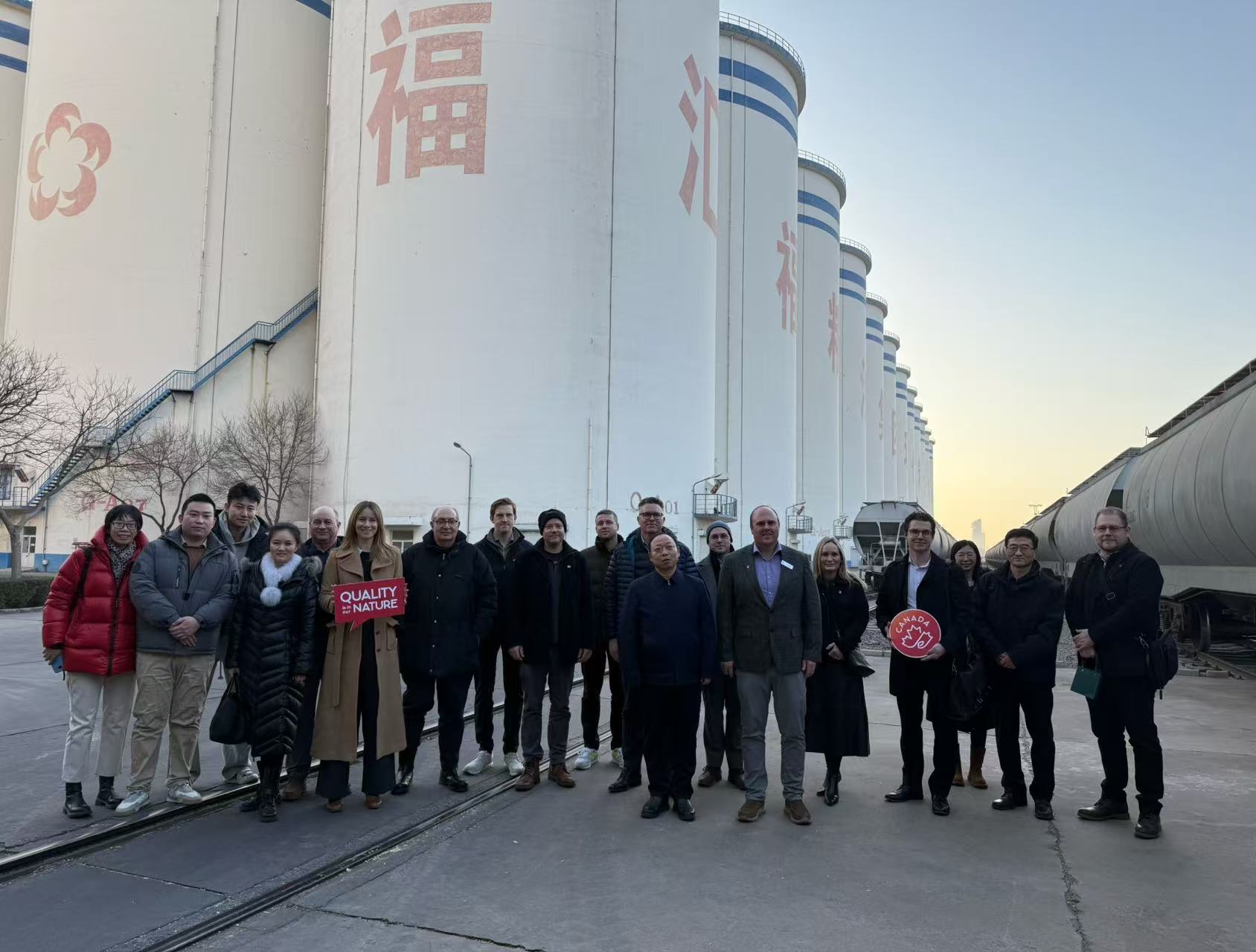
Over the course of the trade mission, the delegation of more than 20 exporters and farmers visited Beijing, Guangzhou, Taipei and Tokyo, touring food processing and soy crush facilities while meeting directly with customers who rely on imported soybeans for a wide range of end uses. For Prince, seeing how Canadian and Manitoba soybeans are handled and transformed once they leave the farm gate added perspective on his contribution to the global market.
“Seeing firsthand how customers are using Canadian soybeans, along with their respect and praise for the quality we produce and the systems we have in place really connects what we do in the field to what they need on their end,” he says.
Taking Canada’s Soybean Story Directly to Buyers
One of the most valuable aspects of the trip was the opportunity to speak directly with buyers and end users. Prince estimates he spoke with more than 250 customers over the course of the mission, sharing how soybeans are grown in Canada, and specifically on his farm, and what goes into producing a consistent, high-quality crop. One customer near Beijing purchased more than one million tonnes of Canada’s 2025 crop, including a significant portion from Western Canada.
Throughout the trade mission, Prince participated in one-on-one meetings with international customers and presented to industry representatives, including local tofu and soymilk processors. The Canadian delegation was made up of representatives from Soy Canada, provincial industry associations, exporters, the Canadian Grain Commission and soybean growers from Manitoba, Ontario and Quebec.
“A lot of customers want to understand where their soybeans come from,” Prince explains. “We talked about our production practices, our climate, last year’s growing conditions and how quality and consistency are priorities for Canadian growers. It was clear throughout our conversations that the trust and transparency Canada provides really matters.”

Those conversations also reinforced an important reality: Canadian soybeans are well regarded, but competition is always present. Buyers have options from multiple countries, and maintaining Canada’s reputation depends on continuing to deliver what customers value most.
“When we meet with customers, they’re often much more familiar with what our competitors offer,” says Brian Innes, executive director of Soy Canada. “Bringing our value chain together to share what Canada can offer, is one small thing we can do to support the value that farmers see from the soybeans they sell.”
Prince points out that Canadian soybeans must compete with countries like Brazil and the United States for Western Canadian commodity beans with a reputation for low and inconsistent protein, that means buyers expect significant discounts.
For some buyers in Japan and Taiwan, quality and traceability are more important, and that’s where Canada has an advantage, especially with our Identity Preserved (IP) soybeans and Soy Quality Programs, explains Prince.
Touring soy food processing and crush facilities also brought that message home. Prince was struck by both the scale of operations, particularly in China, and the sophistication of the processing plants across the countries visited.
“But just as impressive is how advanced and precise these operations are, especially the soy food plants, where customers know exactly what they want from their soybeans, and trust Canada to deliver on their quality expectations,” says Prince.
While food-grade soybeans were part of the discussion, Prince emphasizes the mission was centered on Canada’s ability to deliver high-quality soybeans and a supply customers can trust. IP, or food-grade soybean production represents a small percentage of Manitoba soybean acres today, but it offers a clear example of how understanding customer needs can create added value – for end users and at the farm gate.
“There’s room to grow food-grade production, and that could mean opportunities for premiums on the farm” he says. “But the bigger takeaway applies to all soybeans – no matter what their end use is. Quality, consistency and trust are what open doors.”
Building Trust Beyond Borders
One of the lasting impressions from the trip was the importance of face-to-face relationships. In an era of virtual meetings and digital communication, Prince says meeting with customers and touring their facilities helped build connections and trust.

“Not only do you learn a lot by being there in person, but you get a better sense of what’s important to end users, and they get to know you as more than just a supplier,” he explains. “The in-person meetings are also a key part of their business culture, which makes these outgoing trade missions especially valuable for everyone involved in Canada’s soybean sector.”
For Prince, the experience reinforced the value of global market development initiatives, and the importance of grower involvement in trade missions. Seeing global markets firsthand offers valuable insights and connections, while also highlighting how closely Manitoba farms are connected to customers around the world and gives buyers a chance to learn how Canadian soybeans are grown.
“It changes how you think about the crop you’re growing,” he says. “Once you see where it ends up and who’s relying on it, you realize every decision on the farm plays a role in maintaining, and building the reputation Canada has worked hard to earn, and just how proud I am to be a Manitoba soybean grower.”