
BY: Wendy McDonald, Production Specialist – West, Manitoba Pulse & Soybean Growers
Pea leaf weevils were first observed in Manitoba over five years ago in 2019, arriving from the western prairies into the Swan River Valley. They have moved further south and east every year.
Adult pea leaf weevils are slender, greyish-brown, and approximately five millimetres long. They can be distinguished by three light-coloured stripes on their thorax. They have a short snout (unlike most weevils), and they tend to “play dead” when disturbed.
Adult weevils hide under the snow to survive the winter snuggled in amongst alfalfa and other perennial legume plants in roadside ditches and shelterbelts. The adults emerge in the spring, when temperatures are warmer than 15 C, and fly to field pea or faba bean fields with the aim to reproduce in those locations. Adults seem to migrate in waves from the ditch throughout the spring. Applying foliar insecticide only kills the adults present in the field at the time of application and more pea leaf weevils return in the coming days.

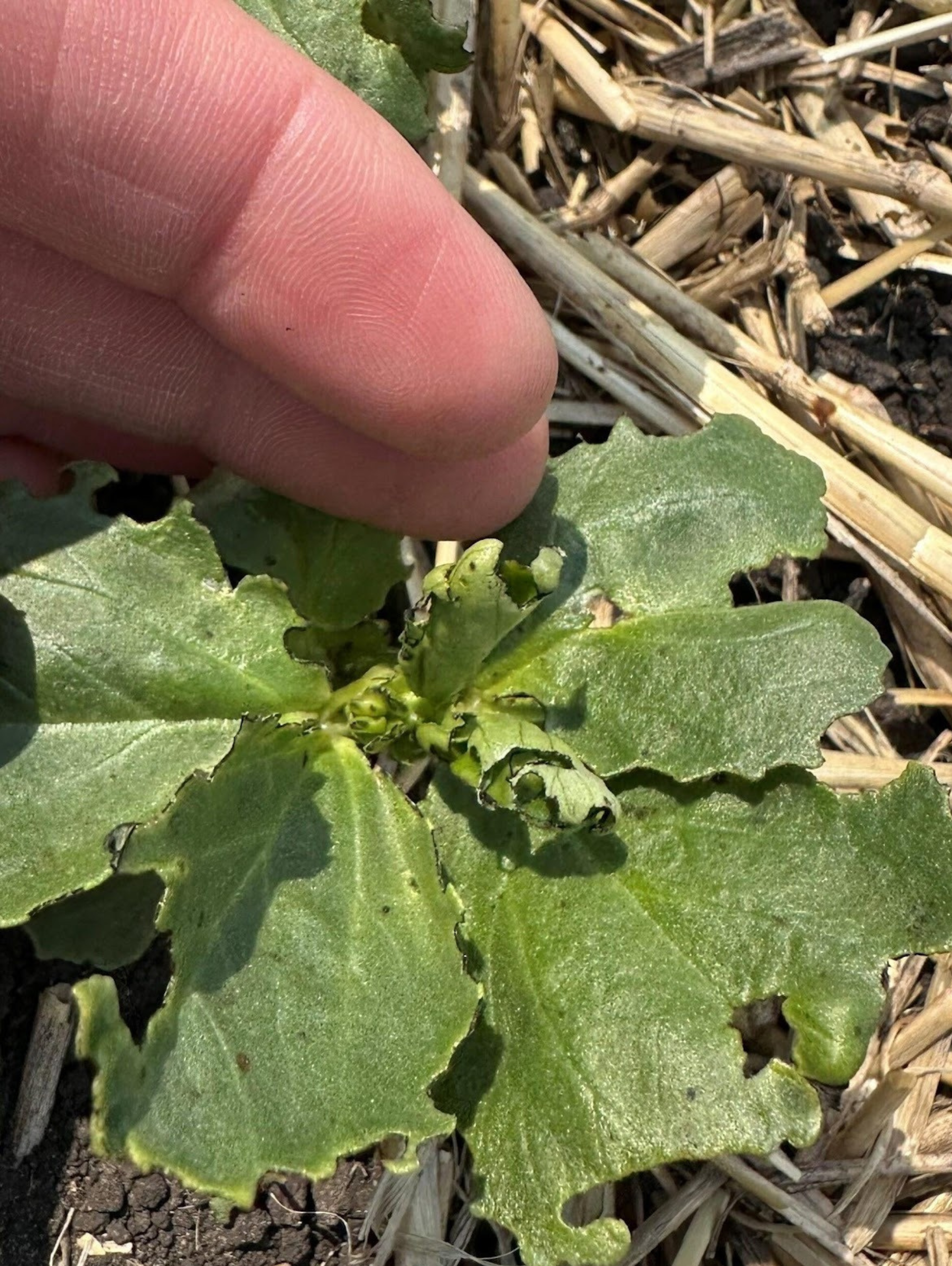
We can tell pea leaf weevils are in a field after we see what they’ve eaten. Pea leaf weevils uniquely nibble only on the leaf margins of peas and faba beans, which presents as crescent-shaped notches like the leaf was hole punched or has scalloped edges. The number of notches on the plants is counted to estimate the size of the pea leaf weevil population is.
Field pea plants can typically withstand 50 per cent defoliation without the damage impacting yields. By the time we see notching, it means the adults have already been there, mated and laid eggs. Females can lay up to 1,500 single eggs on the soil surface or on developing plants as they feed and move throughout the field. Most eggs are laid in May and June and require 18 to 20 days to hatch, depending on temperature and humidity. Eggs are small, smooth and oblong. They are white when laid but turn nearly black at hatching.
In July, eggs hatch and larvae develop under the soil over a period of 30 to 60 days. These larvae grow through five instar stages. They are C shaped and legless with a dark brown head capsule. The rest of the body is a milky-white colour. First instar larvae bury into the soil after hatching and search out root nodules of field pea and faba bean plants.
Larvae enter and consume the microbial contents of the root nodules, basically hollowing them out of any contents. It appears that nitrogen-fixing bacteria are just about the only thing the larvae eat. It’s suspected high pea leaf weevil populations could destroy a large percentage of the nitrogen-fixing root nodules. The larvae feeding on nodules are difficult to observe because they occur underground but may cause significant yield losses and weaken plants, making them less drought tolerant.

When pea leaf weevil larvae have grown to their fifth instar, they are 3.5 to 5.5 millimetres long and burrow into the soil to pupate. Pupation requires 15 to 20 days. The new generation of adults emerge in late July to August. There were reports of large numbers of weevils on cutter bars during the 2025 pea harvest.
When adult pea leaf weevils emerge, they are looking for anything green to eat including volunteer peas that emerge post-harvest. When peas and faba beans are not available, adult pea leaf weevils will consume foliage of any available legumes (wild or cultivated), including alfalfa, clover and vetch. Adult weevils fly to migrate to their overwintering sites.
How Do We Control Pea Leaf Weevils in Manitoba?
To date, Western Canadian research hasn’t found significant protection of yield by applying a foliar insecticide for pea leaf weevils. No insecticide exists that can target those larvae consuming the bacteria inside root nodules, so it’s critical to control adult weevils before they mate and lay eggs.
In theory, a farmer could spray insecticides on a trap crop to control the pests before they emerge or go to over-winter, but that would be very difficult to time appropriately. Insecticide seed treatments can limit adult pea weevil activity and populations early in the growing season, as the insecticide moves systemically through the plant, but it is only effective for approximately two to three weeks following seeding. During this time, when the adult pea leaf weevils feed on new leaves, they ingest the insecticide, which causes them to stop feeding and delay egg laying. This has been shown to reduce the number of larvae feeding on nodules.
Research on management techniques for pea leaf weevils in Manitoba continues to be important. Since no two growing seasons are alike, Manitoba Pulse & Soybean Growers (MPSG) undertook a three-year study on pea leaf weevils examining the effectiveness of seed treatments and how field pea yields were affected.
Insecticide seed treatment is an added cost to growers, and MPSG wants to determine if it is an economical measure for protecting yield in peas. Research was conducted at sites in Minitonas, Roblin and Melita in Manitoba. Anand Aneja, agronomist in residence at Assiniboine College, oversaw the 2025 research, and will be presenting the final results of the three-year study in early 2026.

At each research location, all plots received a pre-plant incorporated herbicide treatment (Authority or Edge), a pre-seed burn off with glyphosate and a post emergent herbicide at the first to sixth true node stages (Viper ADV or Odyssey) to eliminate weed competition. Hand weeding was done to ensure the trial was weed free. Insects and diseases were controlled with registered products if they reached threshold levels.
Experiments included with the following seed treatments:
- Untreated check
- Cruiser 5FS (thiamethoxam)
- Stress Shield 600 (imidacloprid)
- Lumivia CPL (chlorantraniliprole)
There were four repetitions done per site. All plots in each research trial were assessed for plant stand, pea leaf weevil notch counts (at the sixth true node stage) and yield.
While summarizing all locations and results from 2023 and 2024, researchers observed a trend of less pea leaf weevil notching where Cruiser (thiamethoxam) and Stress Shield (imidacloprid) seed treatments were applied. However, this didn’t translate to any yield improvements. It is suspected that pea leaf weevil populations may have been so high at the trial locations that any seed treatment effects were masked by excessive pest pressure.
Another possible explanation for the results seen in 2023 and 2024 is that pea leaf weevils arrive in fields early if warm conditions (above 20 C) persist for more than a few days in late April or early May, resulting in higher yield loss. In years when cool weather persists, such as in 2023 and 2024, the arrival of pea leaf weevils can be much later, and the yield impact less serious.
It should be noted that dry years made plants more susceptible to the pea leaf weevil, which was amply observed at the 2025 trial sites.
In 2025, the Minitonas (Swan River Valley) site got off to a fantastic start. Plots were seeded on May 6, with 10 inches spacing into soil at 12 C and with ample moisture for germination. Peas emerged on May 16, but experienced an extended period with no rain and daytime temperatures reaching above 25 C during the last week of May, with June 1 reaching 34 C. There was no statistical difference between treatments found for plant counts done after full crop emergence.
In hot, dry growing conditions, the Minitonas site demonstrated the highest numbers of pea leaf weevil notching and defoliation that researchers have seen thus far in Manitoba. Feeding was so intense that notch counting at the bottom three nodes of plants couldn’t be completed because all plants were already defoliated in those areas before the counts began.
Data analysis revealed that Cruiser 5FS (thiamethoxam) and Stress Shield 600 (imidacloprid) treated plants had lower notch counts per plant than other treatments. There was no difference in the number of notch counts between untreated plants and Lumivia CPL (chlorantraniliprole) treated plants. There was no difference between any of the treatments for total nodule number per plant, pea leaf weevil larvae number per root, number of pink nodules per root and damaged nodules per root.
After a season of intense pea leaf weevil populations, the Minitonas site was harvested on Aug. 21. There was no statistical difference in yield between any of the treatments and individual plot yields ranged from the high 60s to low 70s bushels per acre. It should be kept in mind that this was only the results for one site in 2025. A final summary of the 2025 results for all of the research sites will be coming soon.
Can You Tell How Much Yield Loss to Expect Based on the Spring Notch Count?
Research has found a significant to note, but overall, relatively weak relationship between the percentage of plants with damage on the terminal leaves and yield loss, Meghan Vankosky, a field crop entomologist at Agriculture and Agri-food Canada’s Saskatoon Research and Development Centre, explains in an email.
“A few other authors also observed similar, weak relationships in field pea. I think that factors like soil quality and larval numbers confound our ability to predict yield loss based on feeding damage,” Vankosky added.

She explained that in the same study, it was found that, despite the number of adult weevils, there were about 12 larvae per plant. Vankosky argued field peas have a carrying capacity for larvae, and that even one female can lay enough eggs to meet the larval carrying capacity of 32 plants (based on the number of plants in their cages).
“Other studies in labs had similar results, where they added 50 or 100 eggs to individual plants and only about 10 to15 adults emerged later. So, while feeding damage gives a rough estimate of population density, it unfortunately doesn’t really allow us to estimate subsequent larval populations, root nodule damage or yield loss,” she said.
What to Expect for Pea Leaf Weevil Numbers in 2026?
According to Vankosky, unless something drastic happens, like a major change in precipitation, the chances are good that areas with high weevil densities last year will have high densities again the next year.
Research conducted around Swift Current, S.K. found that populations of pea leaf weevils completely crashed when there was a period of dry weather. Vankosky’s research found that between spring of 2017 and spring of 2018, it was really, really dry and the next year (2018), they had basically no weevils.
It’s possible the larvae cannot burrow through the soil crust, or they die on the soil surface when the weather is hot and dry.